
The Best Weight Lifting Routine for Thai Boxing
Find Your Personal Trainer
Published: March 25, 2026
Thai boxing demands explosive power, speed, endurance, and resilience. Whether you train competitively or recreationally, strength work can dramatically improve your performance in the ring. A properly designed lifting plan supports harder kicks, faster punches, stronger clinch control, and better injury resistance. Many athletes working with a personal trainer Dubai at home discover that structured resistance training improves striking power and conditioning within 6–8 weeks. The key is choosing movements that transfer directly to Thai boxing rather than bodybuilding-style isolation work. If you’re looking for the best weight lifting routine for Thai Boxing, your training needs to focus on explosive power, rotational strength, and durability rather than muscle size.
Why Strength Training Matters for Thai Boxing
Thai boxing is a high-intensity striking sport that relies on explosive hip rotation, rapid force production, and strong trunk stability. Every kick, knee, elbow, and punch begins with force generated from the ground and transferred through the core before reaching the target. Without sufficient strength and stability, that force “leaks,” reducing power and efficiency.
Research in combat sports shows that core strength training positively affects kick frequency, striking power, and impact speed across striking disciplines. Improved trunk strength also enhances physical stability and movement control, both of which are critical during clinch exchanges and defensive transitions.
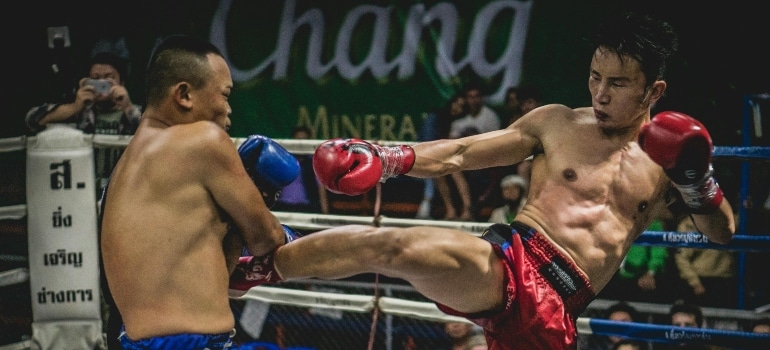
In practical terms, greater strength means:
- Stronger hip drive for roundhouse kicks
- Faster rotational acceleration for hooks and crosses
- Improved balance when absorbing or delivering strikes
- Better control in clinch positions
The best weight lifting routine for Thai Boxing is not designed to build bodybuilder-style muscle mass. Instead, it develops the ability to produce force quickly, stabilize under impact, and maintain mechanical efficiency throughout multiple rounds.
Training Principles for Thai Boxing Athletes
Before jumping into the routine, understand these rules:
- Prioritize compound movements: Multi-joint lifts recruit more muscle groups and mimic fight mechanics.
- Focus on power over fatigue: Heavy lifting sessions should not compromise your pad work or sparring.
- Train 2–3 days per week: More is unnecessary if you already train Thai boxing 3–5 times weekly.
- Keep reps moderate: Strength and power respond best to 3–6 reps for heavy lifts and 6–10 for accessory work.
Weekly Structure Example
If you train Thai boxing 4 days per week, your schedule may look like:
- Monday – Thai boxing
- Tuesday – Strength training
- Wednesday – Thai boxing
- Thursday – Strength training
- Friday – Thai boxing
- Saturday – Optional conditioning
- Sunday – Rest
This prevents overtraining and allows recovery between heavy sessions.
Day 1: Lower Body Power and Core
Your kicks start from the ground. Strong legs and hips directly increase striking force.
Barbell back squat
4 sets x 4–6 reps
Improves leg drive and stability.
Rest: 2–3 minutes.
Romanian deadlift
3 sets x 6 reps
Targets hamstrings and glutes, critical for explosive kicks.
Bulgarian split squats
3 sets x 8 reps per leg
Enhances unilateral balance and reduces injury risk.
Hanging leg raises
3 sets x 10–12 reps
Strengthens the lower core for knee strikes and clinch control.
Farmer’s carries
3 rounds x 30 seconds
Builds grip endurance and shoulder stability.
Day 2: Upper Body Strength and Rotation
Punching power is generated from the hips and transferred through the core to the upper body.
Deadlift
4 sets x 3–5 reps
Develops full-body strength and posterior chain power.
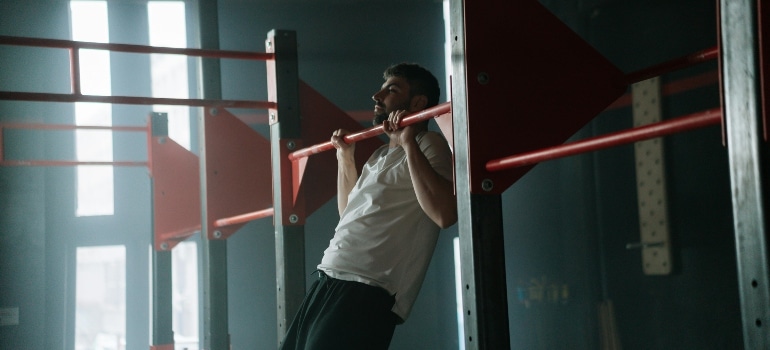
Pull-ups
4 sets x 6–8 reps
Strengthens the back and improves clinch pulling strength.
Bench press or push press
3–4 sets x 5 reps
Improves upper-body force production.
Landmine rotations
3 sets x 8 per side
Enhances rotational core strength for hooks and roundhouse kicks.
Face pulls
3 sets x 12 reps
Supports shoulder health and reduces injury risk.
Optional Power Add-On (Advanced)
For experienced lifters, include explosive movements:
- Box Jumps – 3 x 5
- Medicine Ball Rotational Throws – 3 x 6 per side
- Kettlebell Swings – 3 x 10
These increase the rate of force development, meaning faster and sharper strikes.
Conditioning Without Overtraining
Thai boxing already builds cardiovascular endurance. However, short burst conditioning improves fight readiness.
Add once weekly:
- Sled pushes (6 rounds x 20m)
- Assault bike sprints (10 x 15 seconds)
- Battle rope intervals (6 rounds x 30 seconds)
Keep sessions under 20 minutes to avoid excessive fatigue.
Recovery and Injury Prevention
Combat athletes commonly experience:
- Shoulder strain
- Shin inflammation
- Lower back tightness
- Hip stiffness
To reduce risk:
- Stretch hip flexors and hamstrings daily
- Perform shoulder mobility drills
- Sleep 7–9 hours nightly
- Consume 1.6–2.2g protein per kg of body weight
Athletes who ignore recovery often see performance decline within 4–6 weeks.
Common Mistakes to Avoid
Even with a well-designed program, many fighters undermine progress by applying strength training in ways that conflict with the physical demands of Thai boxing.
Some common mistakes you should avoid:
- Training like a bodybuilder: High-volume isolation work does little for striking performance.
- Lifting too heavy during fight camp: Reduce volume by 30–40% 3 weeks before competition.
- Ignoring core rotation: Thai boxing is rotational. Straight-line strength alone is insufficient.
- Overtraining: More is not better. Performance improves with structured progression and rest.
Sample 8-Week Progression Plan
A structured 8-week progression plan allows Thai boxing athletes to build strength systematically while maintaining technical training and avoiding unnecessary fatigue.
- Weeks 1–2: Focus on form and moderate weight (70% of 1RM).
- Weeks 3–5: Increase load to 75–85% of 1RM.
- Weeks 6–7: Maintain heavy weight, reduce accessory volume slightly.
- Week 8: Deload: reduce weight to 60% and cut sets in half.
How This Applies to Fighters in Dubai
Athletes training in Thai boxing Dubai facilities often combine skill sessions with gym-based strength work. Given the climate and high training frequency, hydration and recovery become even more important.
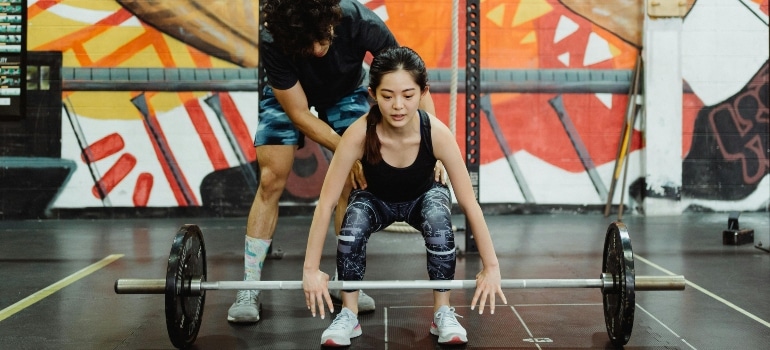
Working with a certified fitness trainer ensures exercises are adapted to your experience level and fight schedule.
Some athletes also cross-train with karate Dubai programs to refine timing and distance control, which further benefits from strength and power development.
Build Strength That Wins Rounds
The best weight lifting routine for Thai boxing focuses on strength, explosiveness, and durability — not muscle size. Two well-designed sessions per week can significantly improve kick speed, punch force, and clinch control within two months. Train heavy but smart. Prioritize compound movements. Respect recovery. When combined with consistent Thai boxing practice, this approach builds a stronger, faster, and more resilient fighter.


 CALL NOW


