
Ways to Improve Your Barbell Bench Press Workout
Find Your Personal Trainer
Published: December 29, 2023
Are you ready to take your bench press game to the next level? Whether you’re a seasoned gym-goer or just starting out with exercises, the barbell bench press is a classic exercise that can help you build a strong and impressive chest. Our experts from DubaiPT Personal Trainers will share some simple and effective ways to improve your barbell bench press workout. No matter your experience level, these tips and techniques will help you lift more, build more muscle, and get closer to that perfect bench press form. So, grab your workout gear, and let’s get started!
Proper Form and Technique Before Everything
Proper form and technique are crucial elements for achieving optimal performance and ensuring your safety. Start by lying flat on the bench with your back, shoulders, and buttocks firmly planted. Your feet should be flat on the floor, and your eyes should be directly under the bar. Grab the bar with a firm grip, slightly wider than shoulder-width apart. Your hands should be even on both sides of the bar.

Lower the bar to your chest in a controlled manner, keeping your elbows at about a 45-degree angle from your body. Avoid flaring your elbows out too wide, as this can strain your shoulders. Take a deep breath before lowering the bar, and exhale as you push it back up. This will help stabilize your core and maintain control throughout the lift. Avoid bouncing the bar off your chest, as this can lead to injury.
Change the Grip Width for Optimal Performance
Everybody has a different ideal grip width based on factors like body proportions, strength, and comfort. However, the muscles you target will depend on the grip width. Here are the three main ones:
- Wide Grip: A wider grip on the bar (outside shoulder width) can emphasize the use of your chest muscles. It may also reduce the range of motion, making it easier to lift heavier weights.
- Narrow Grip: A narrower grip (inside shoulder width) can target the triceps more and may require a slightly larger range of motion. It can be a good variation to work on different muscle groups.
- Standard Grip: A grip that’s about shoulder-width apart is considered the standard and balanced grip. It provides a good compromise between chest and triceps involvement.
Make Gradual Progression in Weights
When you’re just beginning to do barbell bench press or returning after a break, it’s essential to start with a weight that you can lift comfortably with proper form and control. A good starting weight for many beginners is typically the bar alone, which weighs 45 pounds (20 kilograms).
As you become more comfortable and confident with your form and technique, you can gradually add more weight. A common and sustainable progression is to increase the weight by 5-10 pounds (2-4.5 kilograms) at a time, typically weekly or bi-weekly.
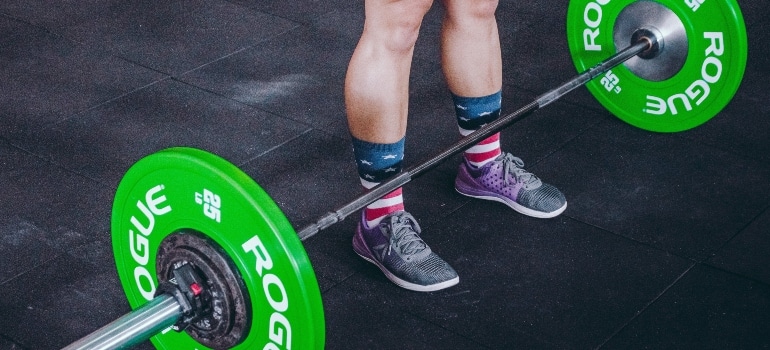
While making steady progress in lifting weights is crucial to your success, having a spotter is equally important. If you struggle to lift the bar, a spotter can assist you by taking some of the weight or helping you re-rack it safely. This reduces the risk of injury.
Incorporate HIIT Principles into Bench Press Workouts
Incorporating HIIT principles into your bench press workouts is excellent for improving your strength, but it is also one of the most valuable fat burning workouts for men. It typically consists of short bursts of high-intensity activity followed by brief rest periods.
To apply this to your bench press workout, perform the exercise with maximum effort for a specific time duration, such as 20-30 seconds.
Following your high-intensity bench press set, take a short rest period, usually around 20-30 seconds. Continue the cycle, alternating between high-intensity bench press sets and rest periods. The number of intervals you perform can vary based on your fitness level and goals, but a typical HIIT session may consist of 4-8 cycles.
Keep in mind that a HIIT workout can be demanding on your body, so it’s essential to allow sufficient time for recovery. Limit HIIT bench press workouts to 2-3 times per week.

Explore Some Workout Apps for Tracking and Motivation
Workout apps offer several advantages, such as tracking your progress by allowing you to monitor your workouts, maintain records of your accomplishments, and assess your performance over time. They also motivate through social features, challenges, and rewards to keep you engaged and accountable.
Furthermore, they offer the convenience of accessing your workouts and monitoring your progress directly from your smartphone, making it effortless to stay on top of your fitness goals. Some of the best workout apps include:
- MyFitnessPal: A comprehensive app that tracks your nutrition, exercise, and weight. You can set fitness goals, log your workouts, and monitor your calorie intake.
- Strong: A straightforward, user-friendly app for strength training. It lets you log your weightlifting workouts, track your sets and reps, and record your progress over time.
- Nike Training Club: Offers a wide range of workout routines, from strength training to yoga. You can choose from guided workouts for various fitness levels and goals.
- Fitbod: A personalized workout app that creates custom fitness plans based on your goals, fitness level, and available equipment.
- JEFIT: A strength training app that offers a library of exercises and pre-designed workout routines. You can create your own routines or use the app’s built-in programs.

Variable Training Techniques to Try Out
As you venture deeper into your bench press adventure, you need to shake things up with variable training techniques. They are essential for breaking through barriers to success, preventing boredom, and challenging your muscles in new ways. Some of the time-tested effective techniques are:
- Drop Sets involve performing an exercise to failure at a given weight and then immediately reducing the weight and continuing with more repetitions until failure again. This technique increases muscle fatigue and stimulates muscle growth.
- Pyramid Sets include gradually increasing or decreasing the weight and repetitions in a workout. You might start with lighter weights and more reps, then increase the weight and reduce the reps with each set, or vice versa. This will boost your nervous system and build both endurance and power.
- Pause Reps require you to take brief pauses at a specific point during a repetition, usually at the most challenging part of the exercise. This technique improves muscle control, increases time under tension, and enhances strength.
- Partial Reps involve performing only a portion of a full repetition, typically focusing on the most challenging part of the movement. For example, in a bench press, you might perform partial reps in the lower or upper range of motion. That way you can build the explosive power needed to fully complete the lift.
These sets can be tough, but with proper form and dedication to pushing your limits, you’ll see substantial gains in both strength and muscle definition. Soon you will start noticing a more resilient and well-rounded chest as well. Just make sure to use these techniques in moderation and with your regular training program to avoid overtraining and injury. Always maintain proper form.
Key Elements to Know if You Want to Improve Your Barbell Bench Press Workout
The best ways to improve your barbell bench press workout involve focusing on proper form, gradually increasing weights, and incorporating effective techniques like drop sets and pyramid sets. Combining these strategies with a well-rounded weight loss exercise program can lead to enhanced strength, muscle development, and overall fitness. Remember, consistency and dedication are key to reaching your goals and maximizing your bench press performance.


 CALL NOW


